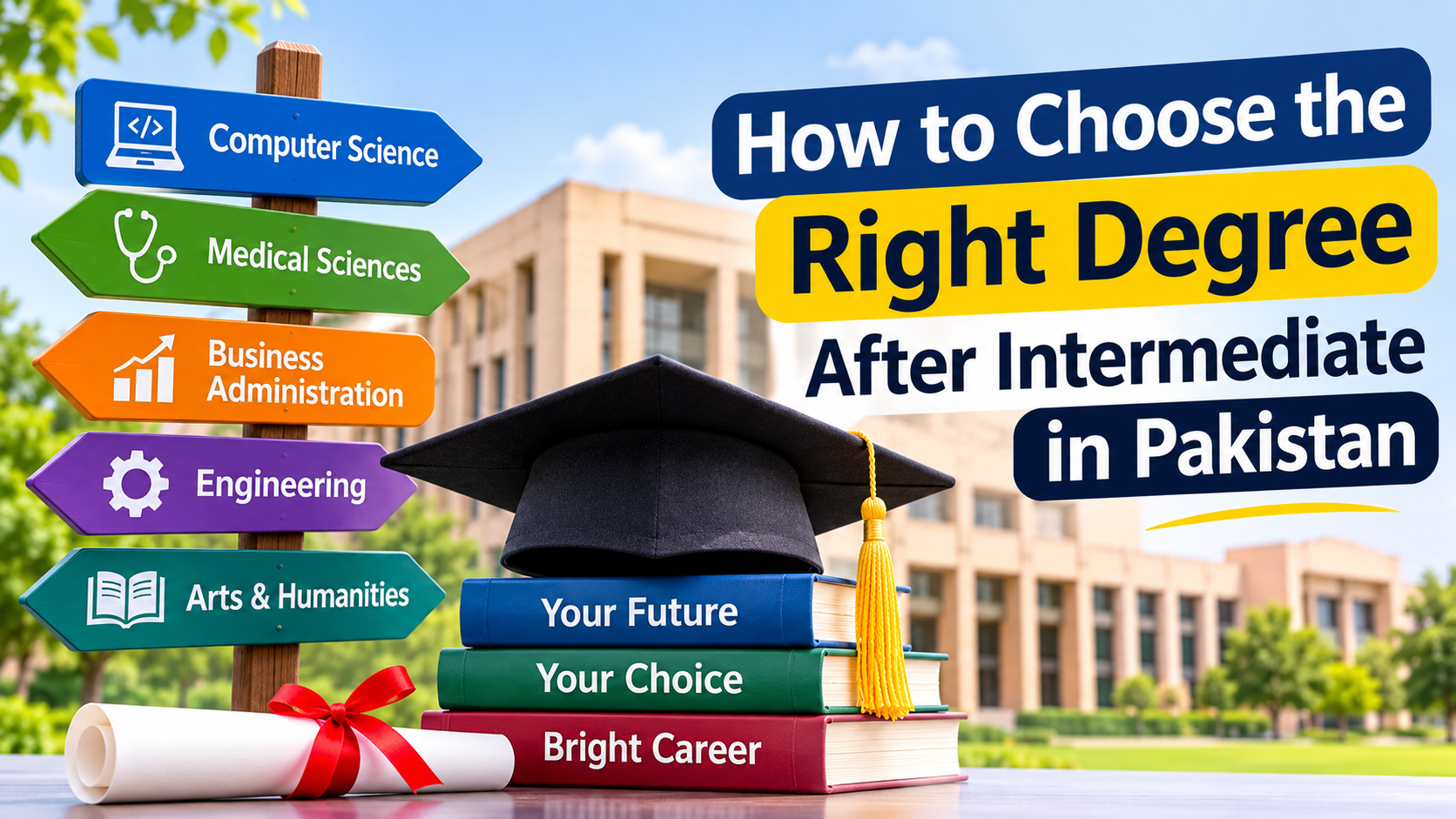
How to Choose the Right Degree After Intermediate in Pakistan: A Complete Student Guide
Completing intermediate education is an important milestone for students in Pakistan. After passing FA, FSc, ICS, or I.Com, students often face an important question: Which degree should they choose for their future?
With several universities, academic programs, and career options available, making the right decision can feel confusing. Some students select a degree because their friends are studying it, while others follow family suggestions without understanding the actual requirements of the field.
Choosing a degree is a personal decision that should consider your interests, academic strengths, financial circumstances, and long-term career goals.
This guide explains how students in Pakistan can evaluate different degree options and make a more informed decision after intermediate.
1. Understand Your Interests and Academic Strengths
Before selecting a university program, think about the subjects you enjoyed during intermediate.
For example:
- Students interested in biology and healthcare may explore medical and life science programs.
- Those who enjoy mathematics and problem-solving may consider engineering, mathematics, or computer science.
- Students interested in business and financial activities can explore commerce, accounting, or management.
- Those who enjoy reading, writing, and social subjects may consider humanities, social sciences, or communication studies.
Your previous academic performance can also help you identify subjects in which you have developed strong skills.
However, do not select a degree based only on your marks. Consider whether you can remain interested in the subject throughout several years of study.
2. Explore Different Degree Options
Students in Pakistan can choose from a wide range of undergraduate programs after intermediate.
Some common options include:
Computer Science and Information Technology
Computer-related degrees may suit students interested in programming, software development, databases, cybersecurity, and technology.
Depending on their qualifications and chosen specialization, graduates may explore careers in software development, IT support, data-related fields, and other technology roles.
Business Administration
Business-related programs introduce students to management, marketing, finance, human resources, and organizational operations.
https://apkswing.com/common-mistakes-to-avoid-when-applying-for-government-jobs-in-pakistan/
Students interested in working with companies, managing projects, or developing business skills may find this field worth exploring.
Commerce and Accounting
Commerce programs focus on financial records, accounting principles, taxation, business operations, and related subjects.
These programs can provide a foundation for careers in accounting, finance, banking, and business administration.
Social Sciences and Humanities
Students interested in society, human behaviour, communication, history, and public affairs may explore programs such as sociology, psychology, political science, English, and related disciplines.
Career opportunities depend on the selected subject, further qualifications, and individual experience.
Engineering and Applied Sciences
Engineering programs focus on technical knowledge, mathematics, scientific principles, and practical problem-solving.
Students should carefully check the required intermediate subjects and admission criteria before applying.
3. Check University Recognition and Program Accreditation
One of the most important steps is checking whether the university and its selected degree program meet the relevant recognition requirements.
In Pakistan, students can use the Higher Education Commission (HEC) website to check recognized universities and degree-awarding institutions.
Some professional programs may also require recognition or accreditation from a relevant professional council.
Before paying admission fees, check:
- Whether the university is recognized by HEC.
- Whether the selected campus is recognized.
- Whether the specific program has the required accreditation, where applicable.
- Whether the university provides the facilities and academic support mentioned in its prospectus.
Do not rely only on advertisements or promotional claims when selecting an institution.
4. Understand the Admission Requirements
Different universities have different admission policies.
Some programs require particular intermediate subjects, while others accept students from multiple educational backgrounds.
Before applying, check the following details:
- Minimum intermediate marks.
- Required subjects or academic background.
- Entry test requirements.
- Merit calculation method.
- Application deadline.
- Required documents.
- Admission fee and semester charges.
For example, a student interested in a computing program should carefully review the mathematics requirements of the university.
Similarly, students considering professional programs should check the latest admission rules published by the relevant institution or regulatory authority.
5. Compare the Total Cost of Education
University education involves more than an admission fee.
Students and families should calculate the expected cost of completing the entire degree.
Important expenses may include:
- Admission and registration charges.
- Semester tuition fees.
- Examination fees.
- Books and learning materials.
- Transportation or hostel expenses.
- Internet and computer requirements.
If a student has financial limitations, public universities, need-based assistance, merit scholarships, and other financial support programs may be worth exploring.
Always check the official scholarship criteria and application deadlines because financial assistance is not automatically available to every student.
6. Research Career Opportunities Before Making a Decision
A degree should support your future goals, but students should avoid selecting a program based entirely on claims about high salaries.
Research the type of work associated with your chosen field.
You can explore career information through:
- University career counselling offices.
- Official job advertisements.
- Professional organizations.
- Graduate career profiles.
- Internship opportunities.
- Conversations with experienced professionals.
For example, students interested in computer science can examine the skills commonly requested in entry-level technology vacancies.
Similarly, business students can research the qualifications and practical abilities required for accounting, marketing, and management positions.
Remember that a degree alone does not guarantee employment. Practical skills, communication, experience, and continuous learning also matter.
7. Consider Distance, Campus Facilities, and Learning Environment
The location of a university can affect your daily routine and educational expenses.
If you plan to study outside your hometown, consider accommodation, transportation, food, and personal safety.
You should also examine the university’s learning environment.
Useful facilities may include:
- Well-equipped laboratories.
- Libraries and digital learning resources.
- Computer facilities.
- Qualified teaching staff.
- Internship and career support.
- Student counselling services.
Whenever possible, visit the campus or attend an official admission session before making your final decision.
8. Do Not Choose a Degree Only Because of Friends or Family Pressure
Every student has different interests, abilities, and future expectations.
A degree that works well for one person may not be the right choice for another.
Listen to advice from parents, teachers, and experienced people, but also conduct your own research.
Make a list of your preferred programs and compare their subjects, admission conditions, expenses, and possible career paths.
An informed decision is usually more helpful than following a popular trend without understanding it.
9. Use Official Sources for Admission Information
Students should collect admission information directly from reliable sources.
The following platforms can help:
Higher Education Commission (HEC): Visit the official HEC website to check information about recognized universities and higher education policies.
University Admission Portals: Individual universities publish their admission advertisements, prospectuses, eligibility conditions, and application schedules through their official websites.
National Testing Service (NTS): Some institutions use standardized tests or other assessment services as part of their admission procedures. Check the relevant university’s instructions.
Professional Regulatory Bodies: Students applying to regulated professional fields should check the relevant council’s recognition and accreditation information.
Always use the latest official information because admission requirements may change between academic sessions.
10. Prepare a Shortlist Before Applying
Instead of applying randomly, prepare a shortlist of universities and degree programs.
You can compare each option using a simple table:
| Factor | What to Check |
|---|---|
| Recognition | HEC and relevant accreditation |
| Eligibility | Marks and required subjects |
| Expenses | Tuition and additional costs |
| Location | Distance and accommodation |
| Curriculum | Subjects and specialization |
| Career support | Internships and practical learning |
This comparison can help you identify programs that match your academic background and available budget.
Final Thoughts
Choosing the right degree after intermediate is an important decision for students in Pakistan. Rather than following trends or relying on other people’s choices, students should evaluate their interests, academic abilities, university recognition, admission requirements, and financial circumstances.
Researching different programs before applying can prevent unnecessary expenses and help students develop a clearer educational direction.
There is no single degree that is best for everyone. The right choice is the program that matches your abilities, interests, and realistic future goals.
Frequently Asked Questions (FAQs)
1. Which degree should I choose after FSc in Pakistan?
Students can explore medical sciences, engineering, computer science, natural sciences, and other programs depending on their subjects, marks, interests, and university admission criteria.
2. Can I study computer science after I.Com or FA?
Admission depends on the university’s eligibility policy and required mathematics or other subject conditions. Students should check the latest program requirements before applying.
3. How can I check whether a university is recognized in Pakistan?
You can visit the official Higher Education Commission website and consult its recognized institutions information.
4. Are public universities less expensive than private universities?
Public universities generally have lower tuition fees than many private institutions, but actual costs vary by university, campus, and degree program.
5. Should I choose a degree based on job opportunities?
Career opportunities are an important factor, but students should also consider their interests, academic strengths, and willingness to develop the skills required in that profession.
6. Can I change my degree after starting university?
Some universities allow students to change programs subject to their academic policies, available seats, and eligibility requirements. Contact the university’s admission office for accurate guidance.
7. Where can I find university admission information in Pakistan?
The most reliable sources are official university websites, admission offices, the HEC website, and relevant professional regulatory bodies.
Disclaimer: Admission criteria, university recognition, program accreditation, and fee structures may change. Students should verify current details through official university and regulatory websites before making an admission decision.